The Half-Painted Wall Is Not a Failure

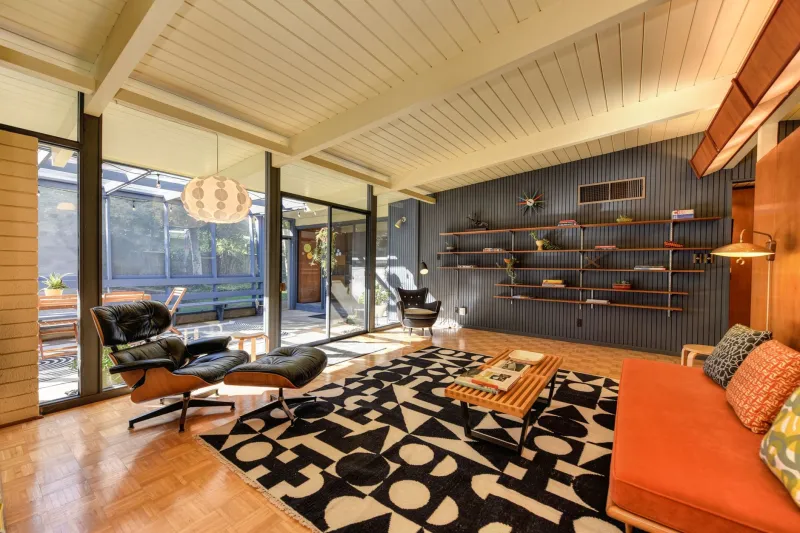
Photo: Mary Harrsch, CC BY-SA 4.0, via Wikimedia Commons
A friend of mine has had painter's tape along her hallway trim for three years. Not metaphorically. Actual blue tape, slightly faded, holding the shape of a decision she hasn't finished making. She apologizes for it every time someone new walks in, and every time the apology takes longer than the tape deserves.
I've started thinking of that hallway as honest. Most of our homes are half-finished. We just hide it in the closet before company comes.
The fantasy of the done house
Somewhere along the line, "renovated" became a state of grace. The reveal photo, the before-and-after carousel, the listing that says turnkey. Between the twenty-teens boom in home-improvement television and the endless scroll of finished interiors online, we absorbed a very specific idea: a house is a project with an end state, and you are behind schedule.
Here's what that idea costs. It makes every room you haven't finished feel like an accusation. It turns a Saturday into a work order. And it produces a peculiar American condition — people who live for years in spaces they've mentally marked as not yet mine, waiting for a version of home that keeps sliding forward like a finish line on a treadmill.
Where the pressure actually comes from
It isn't vanity, mostly. It's a category error. We've quietly merged two different things: maintaining a home and completing a home. Maintenance is real, ongoing, and worth your attention. Completion is a magazine convention that doesn't survive contact with a household of humans.
Meanwhile, the design advice we consume assumes a budget and a clean slate. Real homes have a radiator in the wrong spot, a doorframe that eats one Saturday every spring, and a couch from the old apartment that doesn't match anything and is still the most comfortable thing you own.
Unfinished is a design decision
There's a working term for this in architecture and interiors: the palimpsest — a surface that keeps its own history visible. Layers showing through. Old decisions respected. It's the reason a genuinely well-loved room often reads better than a styled one. It has a pulse.
Living in the in-between isn't the same as giving up. It's choosing which parts of your home do their job now and which parts stay open. A room that's 80% functional is a room you can live in. That other 20% isn't failure. It's headroom.
Six ways to make peace with the unfinished
1. Nominate one construction zone. Pick a single room or project that's allowed to be messy, taped, and mid-stream. Everything else gets permission to be good enough. Containment is what separates an intentional work-in-progress from a house that feels like a stalled job site.
2. Adopt the 80% rule. If it works, it counts as done for now. The shelf is up. The trim is white. The art is hung on a nail that isn't perfectly centered. Move on and stop apologizing at the door.
3. Buy for the life you have this month. The version of you who hosts eight people for dinner in a fully styled dining room may never exist. The version of you who eats standing up over the sink does. Furnish for the second one and let the first one adjust.
4. Say "temporary" out loud. A card table with a tablecloth is a choice, not a defeat. Stating it — even on a sticky note inside a cabinet door — converts a nagging gap into a deliberate placeholder.
5. Keep a “next” list instead of a deadline. Unfinished feels like failure when it's undirected. It feels like momentum when there's a next thing, even a small one, waiting its turn. Write it down. Give it a season, not a date.
6. Do a seasonal review, not a sprint. Four times a year, walk the house and ask one question: what's actually bothering me? Not what a camera would notice. What you notice. That list is always shorter than you fear, and it's the only one that matters.
When unfinished becomes stuck
Honesty requires a caveat. There's a difference between a home in progress and a home you've quietly stopped touching because every decision feels too expensive to get wrong. If a project has been frozen for more than a year and it's making you avoid a room, that's not intentionality — that's avoidance wearing a calm voice.
The tell is simple. In-progress spaces feel alive. Stuck spaces feel avoided. You'll know which one you're standing in.
A house is a verb
Nobody hands you a certificate. There's no closing ceremony where the house is finished and you finally get to relax in it. The people with the most comfortable homes I've been in almost always have something unresolved — a light fixture they haven't picked, a wall of frames waiting on one more photo.
They're not behind. They're living in the thing while it's still becoming. That's not a failure state. That's the whole point of having a home in the first place.